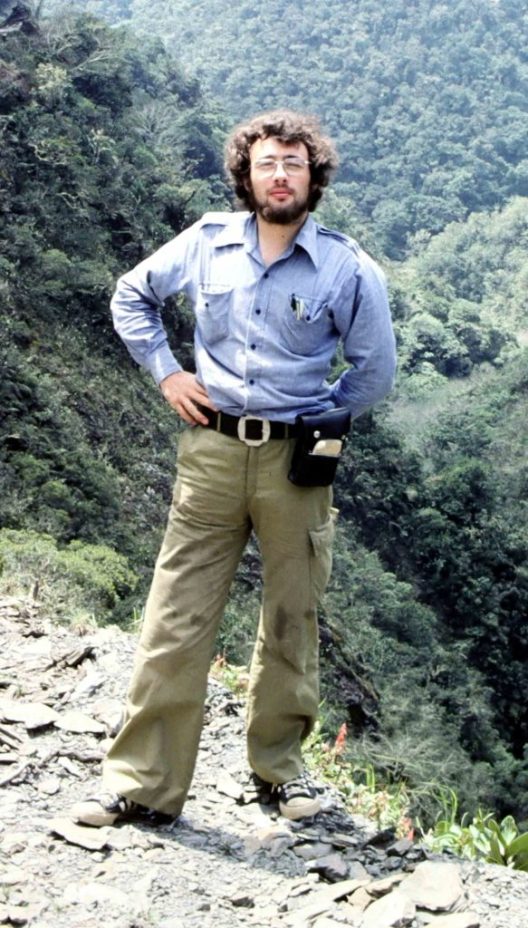
As a schoolboy I had an interest in electronics and built some simple circuits, as well as repairing a couple of radios so I could listen to short-wave stations. I also was interested in archaeology (I worked on several ‘digs’), and collected fossils when on holiday. To add to this, my school was lucky enough to be donated a ‘discovering radioactivity’ kit at the point when the subject had been introduced into exams (‘A’ levels, I would have been 16 or 17). I was keen on the subject, so I got involved in the practical work, measuring radioactivity and using detectors. At University I initially went to do chemistry, but ended up with a chemistry and geology degree.
All of the above came together when I was interviewed for a job with the Institute of Geological Sciences (subsequently renamed British Geological Survey). Unbeknown to me, I was being interviewed for several possible positions, but my interest in electronics and radioactivity determined which one I was offered, in what was then called the ‘Radioactive and Rare Minerals Unit’, part of the Geochemistry Division. (see this introduction page for more about the Unit)
My role initially, was that of an electronics assistant to an electronics technician, who taught me how to repair both field and lab radiometric devices, and use the various instruments and test equipment required. My geology expertise was also required initially for logging boreholes (lowering electronic instruments down and taking measurements) and carrying out field radiometric surveys as part of the uranium exploration work.
By the time I was asked to undertake the work in Peru , I had spent several years carrying out fieldwork in the UK, mostly radiometric surveys, but also field geochemistry soil and stream sampling work. I’d also become involved in a marine research project developing equipment to measure radioactivity on the seabed, with the aim of mapping seabed geology and sediment type based on their radioactivity. This had involved several sea cruises a year around the UK. My expertise in electronics came to be very useful while at sea, and my geological knowledge when collecting and characterising seabed samples.
So, before the Peru project, I was used to working in the field, working in varied weather conditions and driving a Land Rover considerable distances. I’d also had to organise equipment and prepare for the fieldwork. Plus, my electronics experience meant I could set up, test and hopefully repair and maintain the radiometric equipment in the field.
My experience of ‘being abroad’ before Peru was limited to holidays in Spain, Germany and Ireland so had not experienced non-European culture.